Broadway Ticket Sales: The Hidden Economics
Posted on March 13, 2026
Broadway ticket sales rely on a mix of premium, full-price, discount, TKTS, lottery, and rush seats. Learn how tickets are actually sold and what the typical Broadway pricing breakdown looks like.
The Hidden Economics of Broadway Ticket Sales
When people think about Broadway ticket prices, they often focus on the top advertised price—$199, $299, or even far higher for premium seats and top shows. But that number tells only a small part of the story.
In reality, a typical Broadway performance sells tickets across a wide range of price categories and distribution channels. Behind the scenes, producers constantly balance these channels to maximize revenue while still filling the theatre.
The Typical Broadway Ticket Sales Channels Mix
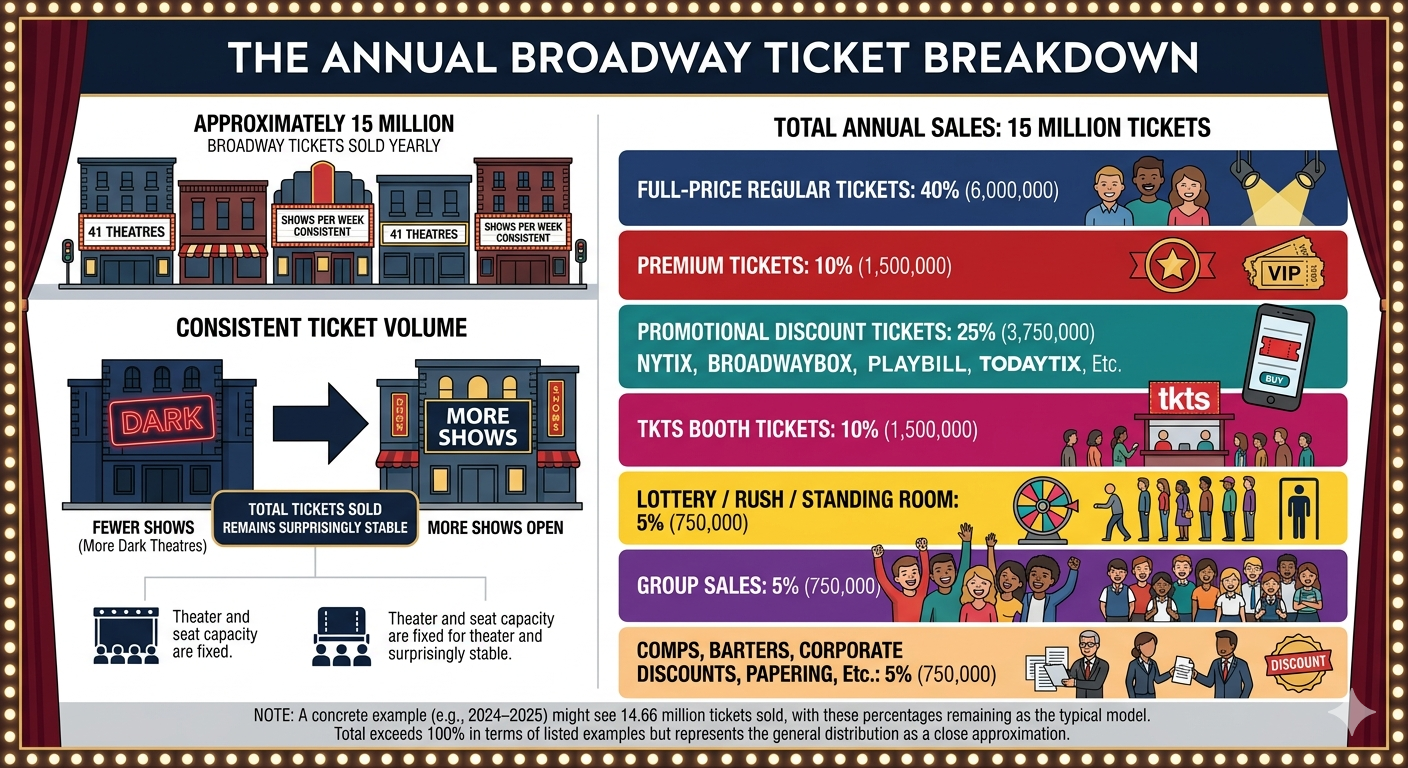
Each year approximately 15 million Broadway show tickets are sold (E.G. in 2024–2025: 14.66 million tickets were sold) This number remains surprisingly consistent throughout the good years as the number of theatres and the number of shows per week remains the same, so the only the number of open shows changes and that can also be seen by how many theatres are dark.
Out of the 15 million total tickets sold, the following are the channel types of Broadway tickets sold and the number of tickets sold per year:
- Full-price regular tickets: 40% of all tickets sold - 6 million tickets in total
- Premium tickets: 10% of all tickets sold - 1.5 million tickets in total
- Promotional discount tickets: NYTIX, BROADWAYBOX, PLAYBILL, TODAYTIX Etc.: 25% of all tickets sold- 3.75 million tickets in total
- TKTS Booth Tickets: 10% of all tickets sold- 1.5 million tickets in total
- Lottery / rush / standing room: 5% of all tickets sold -750,000 tickets in total
- Group sales: 5% of all tickets sold - 750,000 tickets tickets in total
- Comps, Barters, Corporate Discounts, Papering and other swap allocations: 5% of all tickets sold - 750,000 tickets in total
This mix shifts for any individual Broadway show depending on demand, reviews, star casting, and time of year.
The Many Ways a Broadway Seat Gets Sold
Most Broadway seats are sold through traditional channels at the standard advertised price. These tickets are typically purchased online through the primary ticketing service (usually Telecharge or BroadwayDirect) or directly at the theatre box office. For many shows, these full-price tickets make up roughly 35–50% of the house on an average night.
A smaller portion of the theatre is usually reserved for premium seats. These are typically front-orchestra or particularly desirable locations that are dynamically priced above the regular top ticket price. Premium inventory generally accounts for about 5–15% of the house, though for blockbuster productions it can be significantly higher. Ticket brokers would often snap up all these seats and sell them at a huge mark-up - but show producers have got wise to this.
The Role of Discounts
Discounting is deeply embedded in the Broadway marketplace. Producers frequently release promotional codes through email lists, Broadway discount websites, and partner organizations. These offers may reduce the price by anywhere between 20%–50% depending on the show, date, time and seating location.
Across the industry, discounted promotional tickets often account for roughly 15–30% of seats in a typical performance. The exact number depends heavily on demand. A strong-selling hit may release few discounts ( if any), while a struggling show may totally rely on them to maintain attendance.
TKTS and Same-Day Sales
The TKTS booths in Times Square and Lincoln Center serve as a major same-day sales channel for Broadway shows. Tickets sold there are typically discounted 20–50% and are released only hours before the performance.
On average, only about 5–10% of a Broadway house may be sold through TKTS, although this fluctuates depending on how well the show is selling. Tourist-driven productions often rely more heavily on the booth than shows with strong advance sales.
Lottery, Rush, and Standing Room
To maintain accessibility and generate buzz, most Broadway shows offer lottery or rush tickets at very low prices—often between $10 and $49. These seats are distributed either digitally or through same-day in-person lines.
Despite the visibility of these programs, they actually represent a very small portion of total attendance. Industry surveys suggest around 3–7% of seats typically come from lottery, rush, or standing-room programs.
Why the Mix Matters
The breakdown of ticket types plays a major role in Broadway’s economics. A theatre might appear full every night, but the revenue depends heavily on which categories those seats fall into. A house filled with discounted tickets can produce far less revenue than one dominated by full-price or premium buyers.
Producers therefore monitor ticket sales carefully, adjusting prices, releasing discounts, or sending inventory to TKTS only when absolutely necessary. The goal is to strike a delicate balance between maximizing revenue and maintaining strong attendance.
The Reality Behind Broadway Ticket Prices
The headline price of a Broadway ticket can give the impression that theatre is unaffordable. In practice, however, the industry relies on a complex mix of pricing tiers and distribution channels. While some audience members pay hundreds of dollars for premium seats, others attend the same performance for a fraction of that price through rush, lottery, or discounted ticket offers.
This layered pricing structure is what allows Broadway shows to both generate the revenue needed to sustain expensive productions and still keep seats accessible to a wide range of audiences.

Why Some Broadway Shows Never Offer Discount Tickets
Broadway shows vary widely in how much they rely on ticket discounting, and the difference usually comes down to demand.
The biggest Broadway show hits can sell most of their seats without offering any discounts. These productions rely primarily on full-price and premium tickets, often avoiding promotional codes and TKTS entirely. The only lower-priced tickets may be a small lottery or rush allotment offered mainly for accessibility and publicity. For these top-performing shows, 70–90% of seats may sell at full or premium price.
At the other end of the spectrum are shows that struggle to fill the theatre through regular sales. These productions often rely heavily on promotional codes, group discounts, and same-day sales at TKTS. In weaker periods, discounted tickets can account for 40–60% of seats in the house.
Most Broadway shows fall somewhere between these extremes, adjusting discounts and pricing based on demand, reviews, and overall ticket sales.